
Members that follow the forces
Columns and rafters are tapered: deep where the bending moment is high, shallow where it is low.
Why World Steel
An optimised design, built-up members from automatic lines, 3–5 days at sea to Laem Chabang and 0% import duty with Form D. We supply the steel; Thai contractors build. That is how your building ends up lighter, cheaper and on time.
Six reasons
Every frame is engineered for your loads and span, so you pay for steel that works, not steel that sits.
Read moreTapered members welded on automatic lines are typically 20–35% lighter and cost less than hot-rolled sections.
Read more3–5 days at sea to Laem Chabang, 2,500 T a month of capacity and shipments in erection sequence.
Read moreWe only supply the steel. The contract, the site and the client stay with Thai contractors.
Read moreSteel structures made in Vietnam enter Thailand duty-free under ATIGA with our Form D.
Read moreA transparent price per tonne for the steel frame, with a firm quotation for your project.
Read more01 · Optimised design
Steel weight decides most of the cost of a steel building: material, fabrication, painting, freight and erection are all paid by the tonne. That is why our engineers start with the weight, not the drawing.
We design every frame for your real loads and span to Thai and international codes, compare two or three layouts at quotation stage and show you the steel weight per m² of each one. You see where the money goes before you sign.
Columns and rafters are tapered: deep where the bending moment is high, shallow where it is low.
Bay spacing, span and frame type are balanced against purlin size, so the whole building is lighter, not just the frame.
Continuous lapped Z purlins carry the roof with less steel than simple C purlins over the same bays.
Wind to DPT 1311-50 and TIS, seismic zones where they apply, and the crane, solar or ceiling loads you really need.
Standard bolted end-plate connections that our machines make quickly and your erector bolts up fast.
Two or three options with weight and price side by side, so you choose with numbers.
02 · Built-up vs hot-rolled
A hot-rolled section (H-beam or I-beam) comes from the steel mill with one fixed shape along its whole length. The engineer must pick it for the most stressed point of the member, so most of the beam carries far more steel than it needs. Large sizes are made by few mills, often have to be imported, and come in fixed lengths that create offcuts and splices.
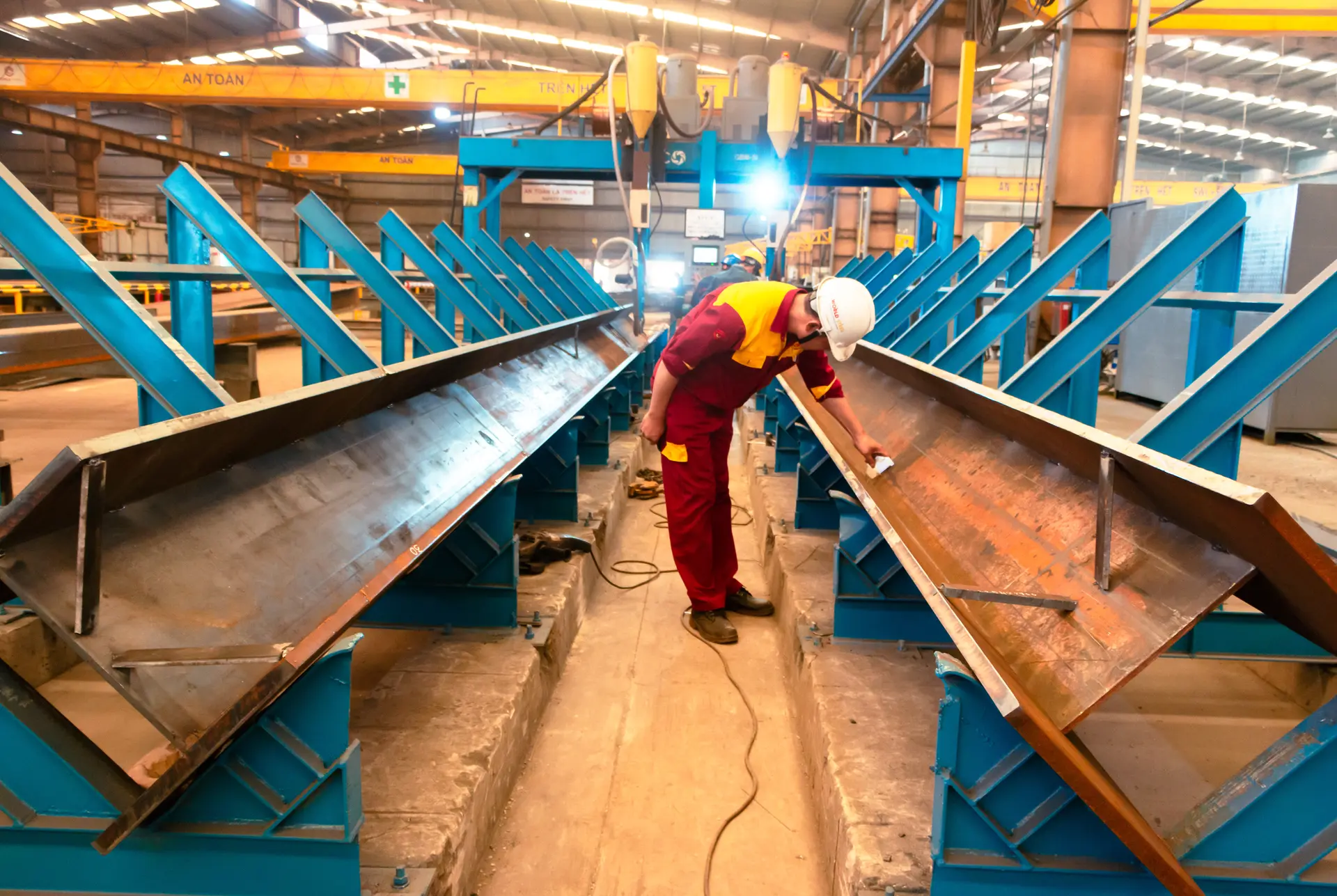
A built-up section is welded from three steel plates: two flanges and a web. Because we cut the plates ourselves, the depth, flange width and thickness can change along the member to follow the bending moment. The web can be thin, with stiffeners where needed. The result is a member with the same strength and far less weight.
Welding used to make built-up members expensive. On our automatic lines it no longer does: CNC machines strip-cut the plates, an H-beam assembly machine fits them, submerged-arc gantries weld both sides in one pass and a straightening machine corrects the flanges. Labour per tonne is low and the welds are consistent and tested. You get the saving in weight without paying it back in fabrication.
| Criterion | Built-up, automatic line | Hot-rolled section |
|---|---|---|
| Shape along the member | Tapered to follow the bending moment | One constant section, sized for the worst point |
| Steel weight of the primary frame | Typically 20–35% lighter on spans above 20 m | Heavier: most of the length is over-sized |
| Available sizes | Any depth and thickness cut from plate, 200 to 1,500 mm deep | Limited to the mill catalogue; deep sections are scarce and often imported |
| Material supply | Steel plate is widely available at a competitive price per tonne | Heavy sections often carry a premium per tonne and minimum order quantities |
| Fabrication | CNC cutting, automatic assembly and submerged-arc welding: low labour per tonne | Less welding, but more cutting, splicing and waste from fixed 12 m lengths |
| Clear spans | Economical from 20 m up to 60 m and more without internal columns | Economical mostly below 25–30 m |
| Freight and erection | Fewer tonnes to ship and lift, smaller cranes | More tonnes to ship, heavier lifts |
| Where it fits best | Columns, rafters, crane beams and wide spans | Small and secondary members, where we still use it |
Warehouse 30 m × 60 m, eave height 8 m, 9 portal frames at 7.5 m, roof and wind loads to Thai codes. Primary frame only (columns and rafters).
| Hot-rolled section | Built-up, automatic line | |
|---|---|---|
| Rafter | H 500×200 constant, about 90 kg/m, with haunches | Tapered 750 → 450 mm, 6 mm web, about 62 kg/m on average |
| Column | H 450×200 constant, about 76 kg/m | Tapered 300 → 650 mm, 6 mm web, about 57 kg/m on average |
| Primary frame steel, 9 frames | about 38 T | about 26.5 T (−30%) |
| Cost index of the primary frame | 100 | about 80 (−20%) |
Illustrative figures. The weight saving is larger than the cost saving because welding a built-up member costs more per tonne than buying a rolled one; on automatic lines that gap is small. For your project we send both options with real weights and prices.
Multi-torch CNC machines cut flanges and tapered webs straight from the shop drawings, with almost no offcuts.
The assembly machine centres the web between the flanges and tack-welds them square.
Gantry welders lay both fillet welds in one pass, with deep, even penetration.
A straightening machine removes weld distortion so members fit on site.
Dimensions and welds are checked and tested against our QC plan before blasting and painting.
We are not against hot-rolled steel. For bracing, small columns, short beams and secondary members a rolled section is often the cheaper choice, and we use it there. The point is to use each where it costs least.
03 · Fast shipping and schedule
Our factory is about 100 km from Cai Mep, with weekly direct sailings into the Gulf of Thailand. Steel reaches a Thai port faster than many projects can finish their foundations.
Approval drawings, anchor-bolt plans and reactions so your foundations start at once
Automatic lines, blasting, painting and inspection in our factory
Trucking to Cai Mep or Cat Lai and export clearance
To Laem Chabang, Bangkok Port, Map Ta Phut or Songkhla
Thai customs and trucking to any province
Enough capacity to start your project without waiting in a queue.
The first frames you erect are the first you unload, so erection starts while we finish the rest.
Anchor-bolt plans arrive in the first weeks, so civil works and fabrication run at the same time.
Questions are answered the same day and you can visit the factory on a day trip.
04 · A supplier, not a competitor
Many Thai contractors worry that a foreign fabricator will go around them to their own clients. With World Steel that conflict does not exist, because we sit in a different place in the value chain.
We are a manufacturer and exporter of goods: we design, fabricate and deliver the steel frame and purlins. We do not bid for main contracts, we do not run sites and we have no erection crews in Thailand. Foundations, civil works, erection, roofing and cladding, MEP and handover are Thai work, done by Thai companies, with permit drawings signed by Thai licensed engineers. We do not even sell roofing or cladding in Thailand.
So every tonne we sell becomes work for a Thai contractor, not a lost job. A lighter, cheaper frame from us makes our partner's tender more competitive, and the margin on the site stays with them.
A lighter, certified steel frame at factory price, built and guaranteed on site by a Thai contractor you know.
Keeps the contract, the client and the site margin, buys the frame at factory price and gets free engineering.
Approves the design to Thai codes with a full calculation package and an IFC model.
Designs, fabricates and delivers the steel frame and purlins to the port or site
| Scope | World Steel | Thai contractor |
|---|---|---|
| Client relationship and main contract | — | |
| Site survey, soil, foundations and civil works | — | |
| Building permit and engineer's signature | Calculations and drawings to support it | |
| Structural design of the steel frame | Review and approval | |
| Fabrication, painting and packing | — | |
| Shipping CIF or DDP | — | |
| Erection, cranes and site safety | Erection drawings and technical support | |
| Roofing, cladding, doors, MEP and finishes | — | |
| Handover and warranty to the owner | Warranty on the steel we supply |
As an overseas manufacturer we deliver goods to a Thai port or site. Building in Thailand is the work of Thai companies, and we stay on our side of that line.
When a contractor brings us a project, we quote that project through the contractor. Prices, drawings and client details stay confidential.
Lighter built-up frames at factory price give you room to win on price and still keep your margin on the site.
Design, weight take-off, 3D/IFC model and a priced quotation, usually within 48 hours, to put in your tender.
2,500 T a month behind you, without investing in a factory, cranes and welders, so you can take on bigger projects.
Every building we supply is erected, roofed, wired and handed over by Thai contractors, engineers and workers.
05 · C/O Form D
Steel structures and their parts are classified under HS heading 7308. Under the ASEAN Trade in Goods Agreement (ATIGA), goods of Vietnamese origin enter Thailand at 0% import duty when a valid certificate of origin Form D is presented.
We fabricate every member in our own factory in Vietnam and issue Form D with every shipment. Your customs broker presents it at Thai Customs; on DDP terms we do it for you. Import VAT of 7% still applies and is normally reclaimable as input VAT.
Plates and members are processed in our factory, which gives the frame its Vietnamese origin.
The certificate is issued by the Vietnamese authority for each shipment.
Electronically through the ASEAN Single Window, with the bill of lading, invoice and packing list.
Your broker declares the goods with Form D at Thai Customs, or we do it on DDP terms.
Your customs broker confirms the final classification and rates for each shipment. CIF & DDP delivery
06 · Price
We quote every project by the tonne, with the steel weight per m² shown, so you can compare offers fairly. Send us your building size and we reply with a firm price, usually within 48 hours.
Get a quotationFAQ
No. For primary frames with spans above about 20 m it usually is, often by a wide margin. For bracing, small columns and short beams a rolled section is often cheaper, and we use it there.
Yes. Tapered members are designed to AISC 360 and EN 1993 with web stiffeners where needed, and our welds are made by qualified procedures and tested. It is the standard way pre-engineered buildings are designed worldwide.
Yes. If a Thai contractor brings us your project, we quote and deliver through them. If you come to us directly, we can recommend experienced Thai erectors.
Yes. You buy the steel frame from us on CIF or DDP terms and appoint a Thai contractor for foundations, erection and the rest of the building.
It is an indicative starting price. The final price depends on the design loads, tonnage, paint system and delivery terms, and is confirmed in your quotation.
We send Form D with the shipping documents. Your customs broker presents it when you clear the goods at the Thai port.
Send us the size and use of your building. We reply with an optimised design, the steel weight and a price per tonne, usually within 48 hours.